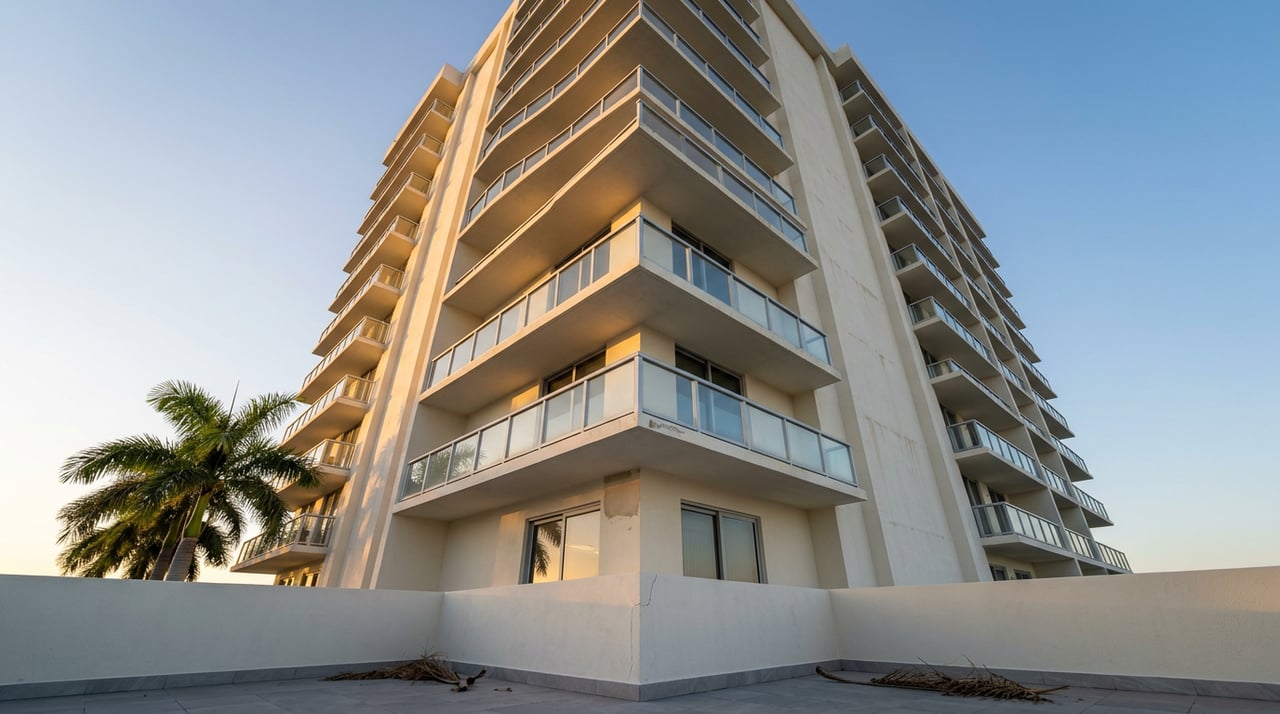
A one-bedroom at the Cricket Club in North Miami came on the market earlier this year with a line in the listing remarks that would send most buyers scrolling past: total HOA and assessments running $2,910.32 a month, with a remaining structural assessment balance of $55,321 still owed on top of that. The building, a 1975 waterfront tower on Biscayne Bay, is mid-restoration. It started funding reserves in 2024. A separate unit in the same building disclosed a building-wide restoration program of roughly $29.5 million, working out to about $134,000 per unit, layered on top of two older assessments still running monthly payments through 2034 and 2036.
Most buyers see a number like that and walk. That instinct is the mistake.
The wrong question is "how big"
In 2026, a Miami condo buyer who screens buildings by assessment size alone is asking the wrong question. The size of an assessment tells you how expensive a building's problem was. It tells you almost nothing about whether the building has actually solved it, or whether the building next door with no visible assessment yet is quietly worse off.
The number that matters is the reserve funding percentage sitting inside the Structural Integrity Reserve Study, or SIRS. A building that reports its reserves at 80 percent funded is in reasonable shape regardless of what its last assessment cost. A building sitting at 30 percent funded is carrying a liability that hasn't been priced yet, even if its monthly dues look modest today. Florida's SB 4-D reserve law, passed after the Champlain Towers South collapse in Surfside, and its 2025 follow-up HB 913 both point buyers toward the same document for the same reason: the assessment history tells you the past, the funding percentage tells you what's coming.
A building like Cricket Club, mid-restoration with a known number and a payment schedule, is arguably easier to underwrite than a quiet 1996-built tower that has never levied an assessment and is about to turn 30 this year.
Why this year specifically
That 1996 detail matters because of how Florida's milestone inspection law is structured. Buildings three stories or taller must complete a Phase 1 structural inspection at 30 years of age, or 25 years for coastal buildings if the local jurisdiction requires it. Anything built in 1996 crosses that 30-year line in 2026, which means a real cohort of Miami-Dade towers is walking into its first-ever milestone inspection this year, with results still unknown. The Florida Department of Business and Professional Regulation sets December 31, 2026 as the outer deadline for completing a SIRS when it's bundled with a milestone inspection, which is the deadline most of this cohort will be working against.
That deadline is also why 2026 looks different from prior years in a way that isn't a coincidence. HB 913 banned associations from waiving reserve funding for structural components starting with budgets adopted after December 31, 2024, and required full funding to begin by January 1, 2026. For decades, plenty of Miami-Dade boards voted to waive or underfund reserves to keep monthly dues low. That option closed this year. The bill for years of underfunding is landing on buildings all at once, which is a large part of why assessments feel newly common rather than a permanent feature of the market.
Buildings that already turned 25 or 30 in the last few years, cleared their inspection, and issued their assessment, like Cricket Club, are past that reckoning. Buildings still waiting on a first inspection haven't had theirs yet.
Reading the same fact two ways
| What a buyer sees | The naive read | The read that holds up |
|---|---|---|
| Large recent special assessment | Building is a money pit, avoid | Building already faced its structural bill, may now be in better shape than an unassessed building nearby |
| No assessment on record | Building is clean | Building may not have completed its milestone inspection yet, especially if built around 1996 |
| Low monthly HOA dues | Good value | Possible sign reserves were waived for years, catch-up assessment likely |
| SIRS shows 80% funded | Same as any other paperwork | Building has genuinely kept pace with its funding schedule |
| SIRS shows 30% funded | Same as any other paperwork | Building is carrying a liability that hasn't been assessed yet |
The three documents worth asking for before you write an offer
None of this is guesswork you have to do alone. Florida law already requires sellers to hand over specific paperwork, and a buyer who asks for it before going under contract, not after, controls the timeline instead of reacting to it.
- The Structural Integrity Reserve Study, which shows the funding percentage against the building's roof, load-bearing structure, waterproofing, and other major systems.
- The Milestone Inspection Report, including any Phase 2 findings, if the building is 30 years or older, or 25 in a coastal jurisdiction.
- A written disclosure of current, pending, and anticipated special assessments, which Florida's condo contract rider already requires the seller to complete.
Florida Statute 718.503 also requires sellers to provide the declaration of condominium, articles of incorporation, bylaws, and recent financials as part of a standard resale package. If a seller can't produce the SIRS or milestone report within a few business days of being asked, that delay is itself useful information.
The liability piece most buyers miss
Here's the part of Florida condo law that catches out-of-state buyers off guard most often. Under Florida Statute 718.116, a new owner is jointly and severally liable with the previous owner for unpaid assessments that accrued before the title transferred. In plain terms, if you close on a unit with an unpaid assessment balance, the association can pursue you for the full amount, not just the seller.
The document that limits that exposure is the estoppel certificate, a statement from the association listing exactly what's owed on the unit as of a given date. Florida law caps the association's ability to collect more than what the estoppel states, provided the buyer relied on it in good faith. Closing on a Miami condo without one isn't a shortcut. It's an open question about what you actually agreed to pay.
In practice, Miami resale transactions in 2026 resolve outstanding assessments one of two standard ways: the seller pays the remaining balance in full at or before closing so the buyer takes title free of it, or the price gets reduced by an amount equal to the assessment. Both are common. Neither works if the disclosure and estoppel process gets skipped or rushed inside a short inspection period.
If you're already in a building facing an assessment
Miami-Dade County's Condominium Special Assessment Loan Program offers help for income-qualified owners covering the cost of required repairs, with loans up to $50,000 per unit at 0 percent interest for households under 140 percent of area median income. The program relaunched on a fully digital application system on June 1, 2026 after a pause that began in August 2025, and its June application window has already closed for this cycle. If you're negotiating with a seller who might have qualified but missed the window, that's one more argument for a price credit at closing rather than assuming a monthly payment plan will simply continue unchanged.
What this means if you're comparing buildings
New-construction and recent-cycle towers in Brickell don't carry the same 30-year reserve catch-up problem, since they haven't hit that age threshold. That's a real trade-off worth pricing in separately, not a reason to treat every older building as equally risky. A 1975 tower that has already funded and executed its restoration, with a documented payment schedule and a transferable assessment, can be a more predictable purchase than a 1996 building that hasn't had its first inspection yet.
The size of the number on the listing was never the useful signal. The funding percentage behind it is.
A few questions worth asking directly
Does an unpaid special assessment follow the unit if the seller sells before it's paid off? Yes, unless the estoppel certificate and closing documents specify the seller pays it off in full. Florida's joint liability rule under Statute 718.116 makes this the buyer's problem by default if it isn't addressed in the contract.
What's the actual difference between a milestone inspection and a SIRS? The milestone inspection is a physical structural evaluation. The SIRS is a financial funding plan built around what that structure will cost to maintain. A building can pass its inspection and still show a badly underfunded SIRS.
How do I find a building's funding percentage before I've made an offer? Ask for it directly when you first inquire about a listing, not after signing a contract. Associations that are in compliance with Florida law should have a completed SIRS available, and a seller's inability or reluctance to produce one within a few business days is worth treating as an answer in itself.
Buying into a Miami tower this year means reading past the finishes and the view line to the building's actual financial position, and that's exactly the kind of diligence Eric Womack walks buyers through before they write an offer, not after they're already worried about one. If you're weighing a specific building's numbers, let's connect.